American Staffordshire Terrier health: conditions, tests and care
The American Staffordshire Terrier is a sturdy dog, but it carries a few inherited conditions you should ask about before you put down a deposit on a puppy. The most useful numbers come from the Orthopedic Foundation for Animals (OFA), which keeps the screening records for the breed in North America, and from a handful of veterinary studies. This page sets out what those sources show, which tests a careful breeder runs, and which signs should send you to the vet.
Lifespan
The American Kennel Club (AKC) gives a life expectancy of 12 to 16 years. A 2024 study of 584,734 dogs in the UK (McMillan et al., Scientific Reports) calculated a figure of 12.5 years for the AmStaff, against 12.7 years for purebred dogs as a whole and 12 years for crossbreeds. The two numbers answer different questions. The AKC range describes a normal adult life; the study is an average taken from death records, so every dog that dies young pulls it down.
Hip and elbow dysplasia
Dysplasia is abnormal development of a joint that leads to looseness, wear and arthritis. It is partly inherited and partly influenced by growth, weight and exercise.
The OFA breed statistics for the AmStaff show:
- Hips: 4,303 dogs evaluated, 25.7% graded dysplastic (18.6% mild, 6.5% moderate, 0.6% severe).
- Elbows: 1,614 dogs evaluated, 18.3% dysplastic, almost all of them grade 1 (16.0%).
Owners and breeders send these X-rays voluntarily, so the figures are not a random sample of the breed. The trend still points the right way. Among AmStaffs born in 1990 or earlier, 31.2% of evaluated hips were dysplastic. For dogs born in 2021 or later the share is 18.0%, although that group is still being screened. A 2017 analysis of the whole OFA database for 60 breeds (Oberbauer et al., PLOS ONE) reached the same conclusion: selecting breeding dogs on X-ray results has reduced both conditions over time.
At home, watch for a dog that is slow to get up, hops with both hind legs together when running, avoids stairs or jumping, or limps after rest. Front leg lameness points more toward the elbows. Treatment runs from weight control and adapted exercise to pain relief and, in some cases, surgery.
Cerebellar ataxia (NCL)
This is the inherited disease most specific to the breed. The dog’s cerebellum slowly degenerates, and coordination goes with it. The AKC notes that signs first appear between 3 and 5 years of age.
A 2010 study of American and French pedigrees (Abitbol et al., PNAS) identified the cause: a variant in the ARSG gene, which produces a late-onset form of neuronal ceroid lipofuscinosis (NCL). In that study, 70% of affected dogs first showed an unsteady gait between 3 and 5 years. The disease progressed slowly. It is recessive, so a puppy is affected only if it inherits the variant from both parents. A 2025 study of affected AmStaffs (Kick et al., Veterinary Sciences) also found reduced retinal function in dogs that already showed ataxia, and owners of 8 of 11 affected dogs reported vision problems.
A DNA test identifies clear, carrier and affected dogs. Of 965 AmStaffs with NCL results registered at the OFA, 0.9% were affected and 24.8% were carriers. The Staffordshire Terrier Club of America (STCA) advises that two carriers should never be bred together and that affected dogs should never be bred. A carrier bred to a clear dog produces no affected puppies, so carriers can stay in a breeding program as long as the other parent tests clear.
The early signs are easy to mistake for clumsiness: stumbling on stairs, swaying when turning, and a high-stepping or wide-based gait that slowly gets worse.
Juvenile polyneuropathy and laryngeal paralysis
A 2018 case series (Vandenberghe et al., Journal of Veterinary Internal Medicine) described 14 young AmStaffs with a degenerative nerve disease. All had weakness in the limbs, and 10 of the 14 also had laryngeal paralysis, where the larynx no longer opens properly during breathing. The pedigrees fitted a recessive inheritance. The disease progressed slowly, and the authors found that dogs that had surgery for the laryngeal paralysis could have a normal lifespan despite their gait problems.
The OFA now lists a DNA test for AmStaff laryngeal paralysis and polyneuropathy. Only 91 dogs had registered results at the time of writing, 7 of them carriers. Noisy breathing, a change in the bark, or a young dog that tires fast on walks all deserve a vet visit.
Skin: allergies and demodicosis
The breed is predisposed to allergic skin disease, according to the veterinary textbook Small Animal Dermatology (Hnilica and Patterson). Typical signs are itching, paw licking, red skin on the belly and armpits, and ear infections that keep coming back. Allergies are managed rather than cured, so expect a long relationship with your vet if your dog has them.
Demodicosis is caused by Demodex mites that live in every dog’s hair follicles and multiply when the immune system does not keep them in check. A study of 1,189,906 dogs seen at 600 US hospitals in 2006 (Plant et al., Veterinary Dermatology) found that the AmStaff had the strongest link of any breed with generalized demodicosis starting in young dogs, with an odds ratio of 35.6. The Staffordshire Bull Terrier came second at 17.1. Look for patches of hair loss on a puppy or young dog, often starting on the face. A skin scraping or hair sample examined under the microscope confirms it, and effective treatments exist.
Thyroid and heart
Both are part of the breed’s screening list. Of 647 AmStaffs with OFA thyroid results, 5.3% were abnormal. The STCA recommends testing breeding dogs every year, because autoimmune thyroiditis can develop after a first normal result. In a pet, an underactive thyroid often shows as weight gain without a change in diet, low energy, a thin coat and repeated skin infections. A blood test settles the question.
For the heart, 1.0% of 2,029 AmStaffs in the OFA congenital cardiac database had an abnormal result. A murmur heard at a puppy’s first checkup should be followed up with your vet, who may refer you to a cardiologist.
The health tests to ask a breeder for
The OFA and the STCA agree on a basic screening list. A dog that completes it and has the results made public receives a CHIC number (Canine Health Information Center). For the AmStaff, the list is:
- Hips: OFA X-ray evaluation or PennHIP, registered with the OFA.
- Heart: a basic exam by a cardiologist or an advanced cardiac exam.
- Thyroid: an evaluation for autoimmune thyroiditis from an approved laboratory.
- NCL (cerebellar ataxia): a DNA test. Puppies of two tested clear parents can be recorded as clear by parentage.
- Optional: an eye exam by a board-certified veterinary ophthalmologist, and elbow X-rays.
The dog must also carry a microchip or tattoo. A CHIC number does not mean every result was normal, only that all of them are on public record. You can check a sire or dam yourself by searching their registered name on ofa.org. If a breeder cannot give you names and results, look elsewhere. Our article is an AmStaff right for you? covers the other questions to ask before you commit.
Weight, exercise and everyday prevention
The AKC notes that some AmStaffs gain weight easily and that treats add up quickly. A lean dog puts less load on hips and elbows. You should feel the ribs under a thin layer of fat with light pressure and see a waist when you look down from above. Weigh your dog every few months on the same scale, and cut the food portion rather than the exercise if the number creeps up.
For puppies, controlled activity is better than long runs on hard ground while the joints are still growing. Our guide to training an AmStaff puppy covers exercise by age. The rest is routine care: vaccinations and parasite control on the schedule your vet sets for your area, and regular tooth brushing.
When to see a vet
Go to an emergency clinic straight away for:
- difficulty breathing or blue or pale gums;
- collapse or a seizure;
- a swollen abdomen with retching that brings nothing up;
- heavy bleeding or a suspected fracture.
Book an appointment within a few days for:
- an unsteady or wobbly gait in an adult, especially between 3 and 5 years (NCL);
- noisy breathing, a changed bark or weakness in a young dog (polyneuropathy);
- patches of hair loss in a puppy (demodicosis);
- constant scratching, paw licking or repeated ear infections (allergies);
- lameness that lasts more than a couple of days (dysplasia or injury);
- weight gain with tiredness and a poor coat (thyroid).
If you are comparing breeds, the health profile differs in useful ways from that of the Staffordshire Bull Terrier: see our AmStaff vs Staffordshire Bull Terrier comparison.
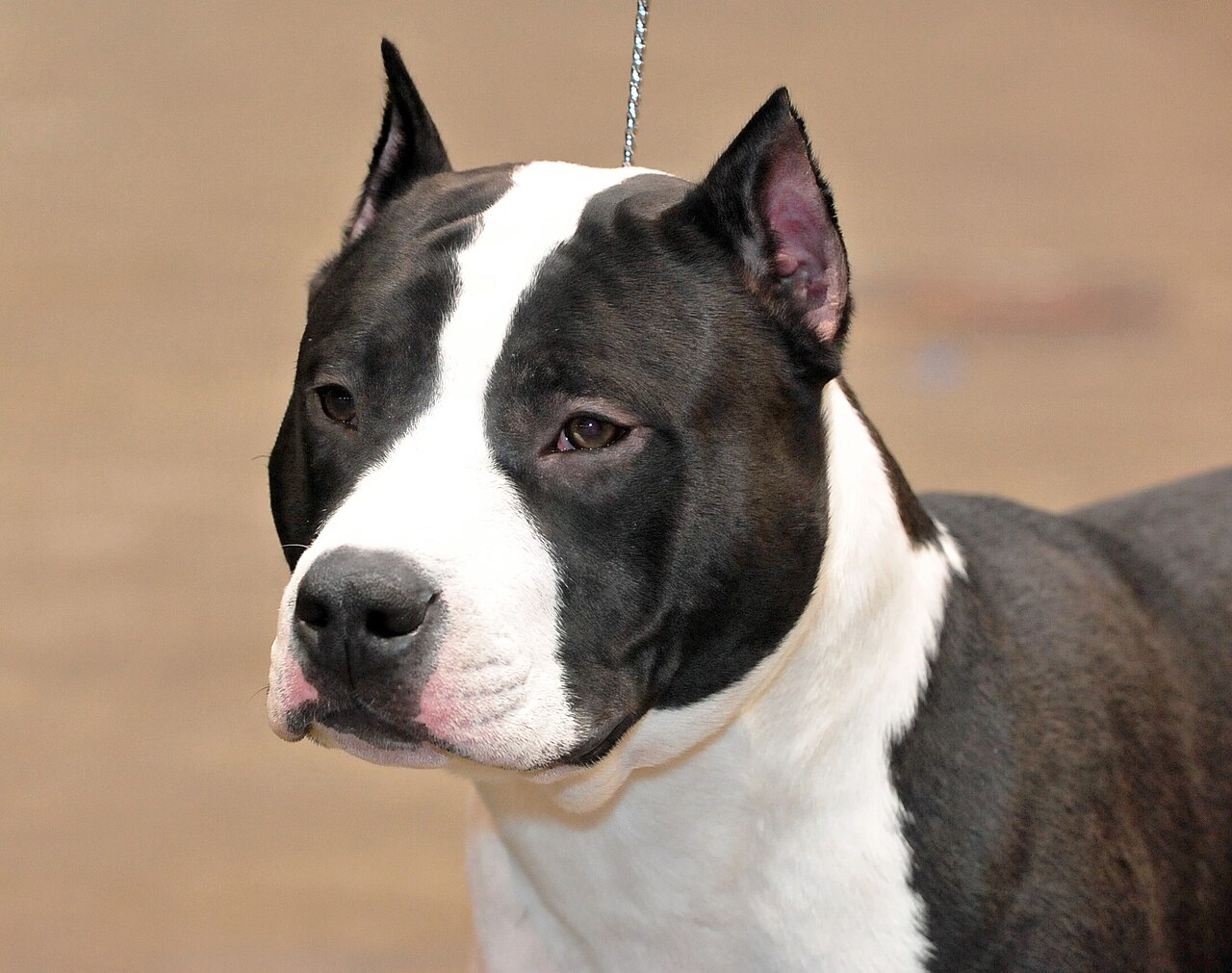
Photo: State Farm, Wikimedia Commons, CC BY 2.0.